
Turning a Vision into Reality

What’s not to love about a vision to reduce one’s carbon footprint while saving money at the same time? As some might say, it’s a no-brainer.
Each year, Earth Day serves as a reminder of why it's important to turn that kind of vision into reality. If I truly want to safeguard the planet for future generations, then finding ways to lessen my carbon footprint is one small but meaningful step I can take.
We all have a carbon footprint, and becoming aware of mine created a bit of internal tension. Living in a three-bedroom home and owning a vehicle naturally comes with a certain level of impact. If many of us live this way, is it sustainable long-term? And if not, what can I realistically change?
As I sat with those questions, two ideas kept coming to mind: installing solar panels and driving an electric vehicle. Both felt like tangible ways to move toward a more sustainable lifestyle and live out a commitment to creation care.
That was the vision.
Here’s how it became a reality.
Living in Alberta, we were able to look into the Greener Homes Canada program, which at the time offered an interest-free loan. While that specific program isn’t currently available, similar grants often exist depending on where you live.
The process began with a home energy audit. This step looks at how efficient your home already is, including things like insulation, windows, and potential air loss. At first, it can feel like an extra hurdle, but it makes sense. If you’re investing in solar, it’s worth ensuring your home is using energy as efficiently as possible to begin with.
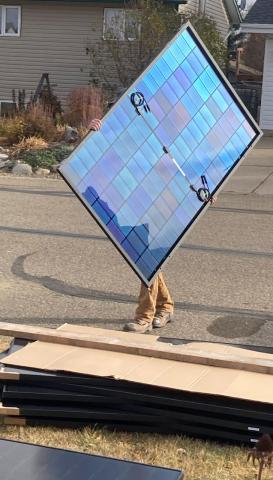
Once the audit was complete, we connected with a solar company. They reviewed our past year of energy use, both electricity and heating, to understand how much power our home actually consumes. From there, they designed a system sized to match that usage, creating a plan that could generate a similar amount of energy over the course of a year.
After submitting the plan for approval, everything started to feel more real.
We were approved, and with that came the next steps of ordering the panels, arranging installation, and coordinating the electricians. Since we also drive an electric vehicle, we decided to install an electric car charger at the same time, making the transition even more aligned with our goals.
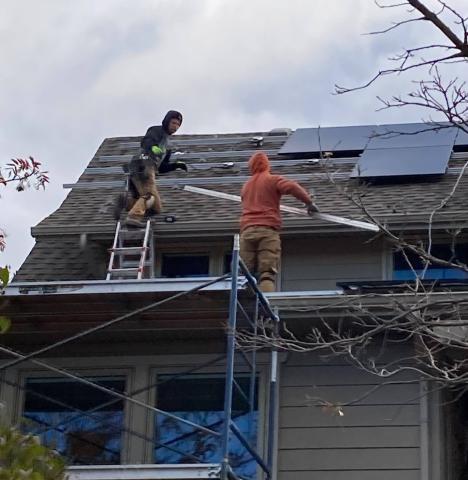
Installation day was a milestone. Watching the panels go up, carefully positioned to catch the most sun made the whole process feel tangible. Each panel is attached to the next so that the energy current will flow through to an inverter and then to the circuit breaker in the electrical panel. In our case, the breaker box needed to be upgraded to a higher level of amperage to carry the extra power that would flow through it.
One of the most rewarding parts has been seeing it all in action. Along with the inverter there is a current transformer that reads how much power your home is using and how much energy the solar panels are producing. This is connected to an application that allows us to see this in real time. The app displays it in an input output format as well as a graph measuring this production and usage over the hour, day or month. We can open the app on our computer devices to keep track of energy made and energy used. It’s a simple but powerful reminder of the shift we’ve made. Even on cloudy or semi cloudy days there is electricity being produced and generated by solar panels.
Turning a vision into reality rarely happens all at once. There are steps along the way, and sometimes a few unexpected turns. But looking back, the satisfaction of knowing that I have lessened the amount of carbon produced in my day to day living is of great value. As more and more people are installing solar on their homes and elsewhere, the conversation often centers around the reasons why we do this. Often it is because of ways to save money but we like to emphasize that the value lies in the fact that it is clean and renewable energy. Even today on a partly cloudy day I am so excited to see that a technology such as a solar panel can produce electricity that goes directly into powering my home and it is not putting pollutants in the air.
As a strong proponent of Creation Care, I am grateful for the technology that generates power from the sun. I love that my carbon footprint has been significantly lessened, and that our car is not creating emissions that harm our global community. I am grateful for this opportunity to be a steward of the land that God has entrusted to us.
Find more energy stewardship tips from the Climate Witness Project here.


