
The Water of Life

I love having the great privilege of spending a few days out on the water during the summer in the Pacific Northwest. The vast expanse of a calm flat ocean, watching the sun rise or set, reminds me of the expansiveness of the glory of God.
One of my favorite passages in the Scriptures reminds us of the value of water, found in the Gospel of John. When Jesus offers water to the Samaritan woman at Jacob’s well, he tells her this: “Everyone who drinks this water will be thirsty again, but whoever drinks the water I give them will never thirst. Indeed, the water I give them will become in them a spring of water welling up to eternal life” (John 4:13-14). Upon hearing the promise of such living water, the woman responds, “Sir, give me this water, so that I will never be thirsty again.” Water not only reminds us of the expansiveness of God, but of the promise that He is the one who fulfills, sustains, and gives us access to eternal life.
Promises of fulfillment and eternal life are most welcome in these times of hardship as wars continue to rage around the world, especially in the Middle East. I sometimes don’t know what to make of the juxtaposition of the peace and tranquility of the islands of the Pacific Northwest with what I have seen and know to be true about places such as Gaza, Palestine, Iran, and other parts of the Middle East.
In April 2024, I co-wrote an article for The Christian Century called “In Gaza, water is life. Fresh water was scarce even before the war. Now the situation is dire.” Now more than two years later, clean water continues to be a commodity that is challenging, if not impossible for the average person in Gaza to access. When hearing about the experience from a local Gazan named Ahmad, he said: “If you have water, you are going to get sick because it’s bad. If you don’t have water, you are going to get sick because you need water.” That catch 22 was described about the situation in 2024, and now in July 2026, the situation remains. He described the reality of lack of water as being a subversion of “water as life” and instead described “this water as death.”
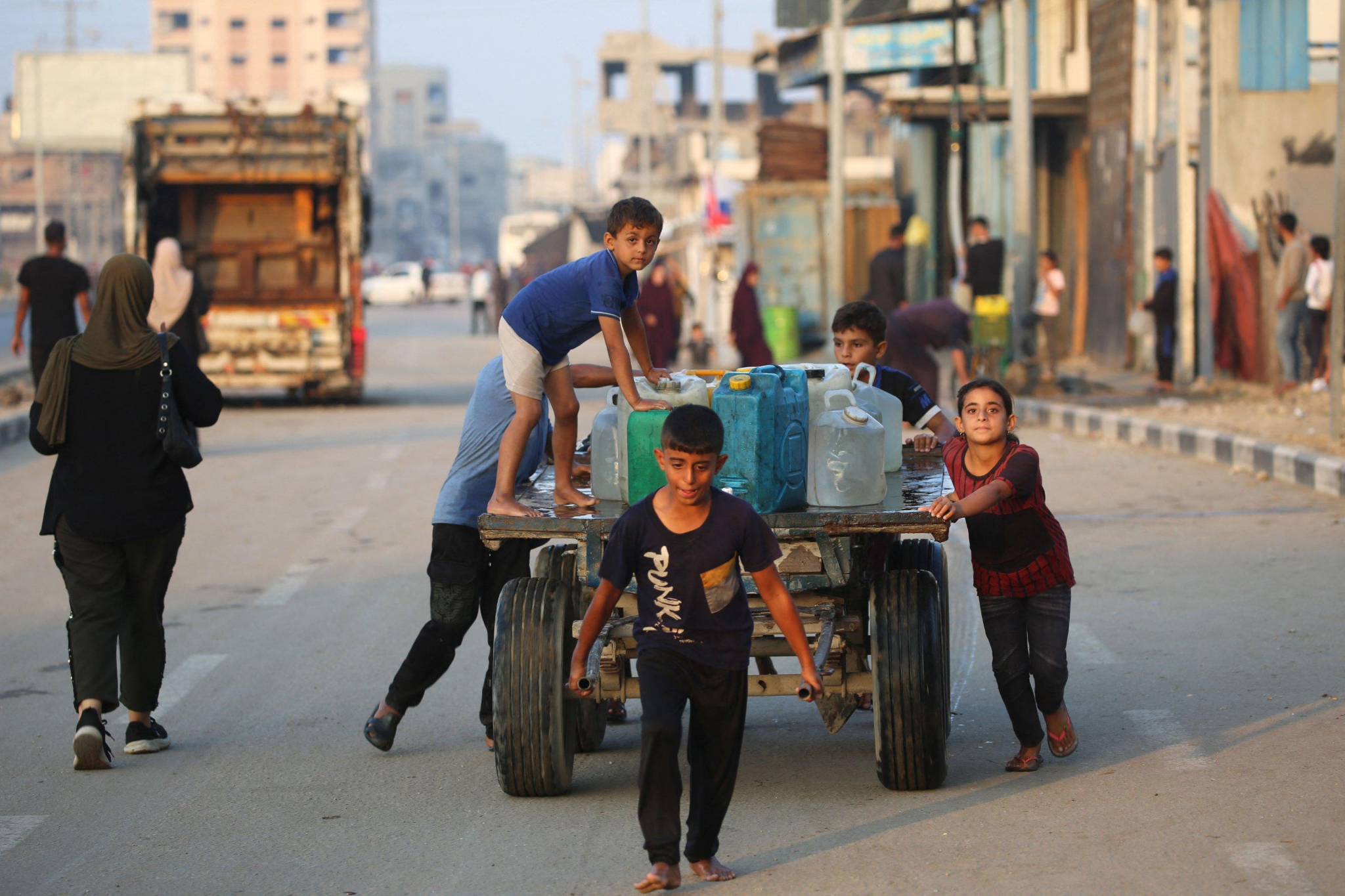
Photo: children collecting water amid the destruction in Gaza. It was photographed by Fadi Thabet for UNRWA on April 1, 2025. Wikimedia Commons confirms a CC BY-SA 3.0 IGO license, which permits reuse with attribution.
According to UNICEF’s July Report, the statistics of water in Gaza conclude that 82 percent of families there continue to experience water insecurity. Up to 70 percent of people are unable to access at least six liters of water per day for drinking and cooking, which is less than the half of 15 liters per person per day is the international emergency standard. Nearly 90 percent of water and sanitation infrastructure are damaged or destroyed and more than 1.1 million children in Gaza are affected by water scarcity.
Returning to Jesus, how are Christians called to respond to these circumstances? The Bible has something to say about water in times of war: “If your enemy is hungry, give them food to eat; if they are thirsty, give them water to drink” (Proverbs 25:21). An immediate response? I would assert that the people of Gaza are not our enemy, but even if they were, God commands us to “provide water to those who are thirsty.” We must get more water to the people of Gaza. There are more than 2,700 water collection points in Gaza that are reaching about 1.6 million of the 2+ million people in the population. Trucking is an intermediate solution, not a permanent one. In addition to the emergency disaster response, there must be a rebuilding of the water infrastructure systems so that water can be delivered through pipes and sustainable systems. The only lasting solution to the water crisis in the Gaza catastrophe is to end the circumstances of war and violence, and to come to a longstanding peaceful and negotiated resolution that will allow for security, safety, peace, and justice for not only the people of Gaza and Palestine, but for Israelis as well.
What does the John passage teach us amidst these circumstances? The woman at the well, a Samaritan woman, was a part of the rejected class of the day, stigmatized and viewed with suspicion because of religious and political reasons. She would not have been addressed by a Jewish traveler, as she would have been viewed as suspect, and most likely unworthy. But Jesus chooses a different way, not only engaging in conversation, but offering her water to drink - not the water of the well, but living water that offers eternal life.


