
Native Plants and Next Steps

“What can our church do together to join in God’s work of restoration and renewal so that all things might flourish?”
This was the question posed to a group gathered on Sunday morning before worship at Waterloo CRC. Last fall, Michael Ott had led a series entitled “Earth Systems: That All Things Might Flourish". In that series, we learned more about how the systems built into creation are integrated, complex, and resilient. We also learned the term “Triple Threat.” This term refers to the triple threat to the flourishing of all things: pollution, climate change, and loss of biodiversity.
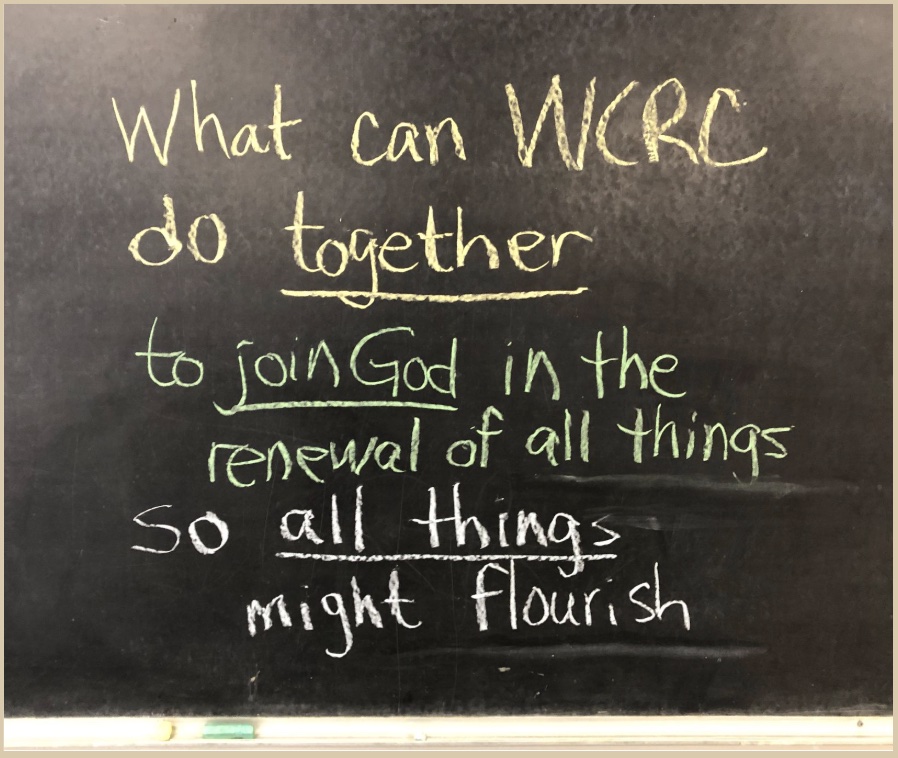
On May 31, 2026, a group of 16 people gathered to generate ideas of how Waterloo CRC, as a community, could respond to this triple threat. Believing that God is already active in the work of restoration and renewal, we want to be faithful and choose to be a part of that work. And we know that this work is not only for the benefit of humans–but for the benefit of “the whole community of creation” of which humans are a part.
The gathering began with a reading of Colossians 1:15-20. The passage repeats the term “all things / all creation / everything” 7 times in 5 verses. Speaking of Christ, the passage says “.. all things have been created through him and for him.” “In him all things hold together.” “ through him God was pleased…to reconcile to himself all things.” The passage became the invitation to join Christ in the work already begun–the work of reconciling and restoring all things–from the relationships between humans and God to the relationships between humans and all other parts of the “community of creation” of which we are a part.
Over the hour that we spent together, people shared their motivation for responding to the triple threat. We generated ideas of how the Waterloo CRC community could respond together to the threat of biodiversity loss, pollution, and human-induced climate change. We then posted the ideas under the headings of these three threats. Next, we broke into three teams to group similar ideas and sort them into short-term and long-term. Each participant was then given dots that they could use to vote for their preferred ideas.
Short-Term: Native plant gardens
The top short-term idea is to add more native species of plants to the land the church sits on. This would respond to the loss of native plants caused by agriculture and development and provide increased natural habitat for birds and insects–especially pollinators which are so important for many food crops. The planting of a native plant garden could also provide an opportunity for Waterloo CRC to learn from Indigenous Peoples about traditional local plant knowledge.
Since the May 31 meeting, Waterloo CRC’s Stewardship Committee has given its endorsement to the proposal to add more native plants.
Long-Term: Solar electricity generation and sharing facilities
The top long-term idea is to add solar panels to the roof of the church to generate electricity from the sun’s energy. As we move away from fossil fuels and towards electrification, this would add to the supply of electricity through technology that, after installation, does not produce climate-changing carbon emissions. The second long-term idea is to see the church property include affordable housing and dedicated community use space. This would contribute to the flourishing of people in our community while avoiding some of the carbon emissions required to create and operate a separate facility for these purposes. In our community of Kitchener-Waterloo, we have at least three local examples of churches partnering with housing providers like Indwell and Beyond Housing to provide deeply affordable and supportive housing.
Next Steps
Having received Stewardship’s endorsement of the native plant project, the next step is to walk the property with a person that has experience in native plant gardens. That walk will help identify appropriate locations for the gardens and it will help us choose plants and set a budget and timeline for the work which will most likely happen early fall.
We also hope to meet with Stewardship to learn about past conversations about solar panels and energy efficiency of the church building. With the knowledge of what has been discussed and decided in the past, we hope to plot a path forward.
Other ideas generated for later consideration are:
- Diverting stormwater from the sewer system through permeable surfaces in the parking lot
- Researching heat pumps (air source or geothermal) for future heating and cooling
- Education series on food choices and their impact on the community of creation
- Education series on choosing household products that are less polluting
- Advocating for free public transit
- Education: a zero-waste challenge for the church
- Education: green burial options
- Another “Season of Creation” (September 1 to October 4) series to help us develop a theology of creation more shaped by scripture than by culture
- More frequent “Walk to Worship” events encouraging the church to think of our choice of commute as a part of our worship of the Creator.


