
Curiosity and Wonder

Botany, according to the dictionary on my desk, is “a branch of biology dealing with plants and plant life.” It also states that a botanist is someone who studies botany. Our level of botanical knowledge today far surpasses that of the people mentioned in the Bible. Yet they, too, were good observers of the natural world and learned about plants much like we do today.
Solomon received wisdom from God for dealing with the affairs of people. I Kings 4:30 states that his “wisdom was greater than the wisdom of all the people of the East, and greater than all the wisdom of Egypt.” A few verses later we get a glimpse into the kind of reflections that must have occupied some of his time. In verse 33: “he [Solomon] spoke about plant life, from the cedar of Lebanon to the hyssop that grows out of walls.” And, “he also spoke about animals and birds, reptiles and fish.” To speak about something suggests there has been learning, study, and careful observation.
Solomon spoke about enormous cedar trees and the small, yet essential hyssop, or ezov plant. The cedar timbers used for building the temple had heartwood that did not rot, twist, bend or break. The hyssop, which still grows on the walls of the Temple Mount, was used in Passover, ritual sacrifices, and purification. It seems clear that Solomon was a man who wondered, observed, and learned about the natural world with patience and wisdom.
For my part, wonder and curiosity have played a significant role in shaping my life and education. I remember the first time I saw a Ruby-throated Hummingbird hovering near the plants at our house. I was probably ten years old. While I had heard of these birds, I had never seen one—until that afternoon. There it was, a tiny green gem, unlike anything I had seen before, in “my” place, feeding on the nectar in our garden. I didn’t know it at the time, but that small bird had likely just come from the forests of Central America.
Years later, when I did start watching birds more intentionally, I was again astonished by what I found. In the mid-70s we moved “out of town” to a piece of land that included a floodplain forest. It wasn’t large, but I soon discovered that it was a welcome stop for migratory birds, especially warblers. If you take a look at the bird list included on this post you’ll see that in the span of three weeks in the spring of ‘82, I saw birds that had, like the hummingbird, just returned from distant tropical forests. Even more remarkable was that I saw most of them in an area the size of a classroom.
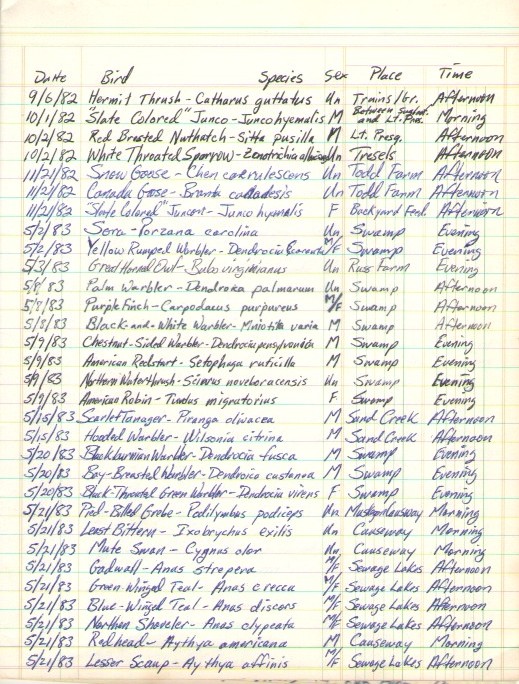
It was a feeding flock: small birds moving together through the lower canopy to feed in greater safety. They needed to replenish after their long journey. Hawks and owls need to eat as well, so I imagine a few warblers were lost over the course of that summer. That, too, is part of the natural world—either a passive or active form of the verb “to eat.”
Wonder is something we pass on, sometimes knowingly and sometimes not, to those around us. We can spark it in simple ways: a terrarium for a reptile, an autumn leaf collection, visiting the same park again and again, or exploring new ones. Nothing needs to be far away. Often, what we need is close by—it simply needs to be noticed and explored. And it need not be removed from urban areas.
We often stayed in a midwestern city in the U.S., with a population of about 500,000. Like many large cities, it had its share of traffic, stores, and restaurants. Yet less than half a mile away was a wild area where one could see Barred Owls, White-tailed Deer, American Mink, black, red, and grey squirrels, Red Fox, opossum, raccoons, and many other creatures.
Our earthkeeping begins with wonder. Wonder leads to curiosity, which leads to knowledge, and eventually to appreciation—and finally a deep concern and passion for caring for God’s beautiful creation. My own path has kept me in the natural sciences, now combined with mission work, so I have stayed, as the saying goes, “hoeing in the same row.” But no matter our career or profession, we are all stewards, all the time.
Where can you go these days with a young person to find a natural setting and explore? How far away is the nearest township, county, or city park? How close is the nearest state forest or campground? Do you know someone who enjoys fishing, birding, canoeing, hiking, caring for animals, or growing plants? Just imagine what mighty cedars of Lebanon or tiny hyssop you might encounter along your journey through God’s “wonder”-ful creation.


