
The Belhar Confession: Road Map to Unity, Reconciliation, and Justice

I am indebted to the Christian Reformed Church in North America (CRCNA) and other Reformed traditions that have given heed to the profound contributions of the Belhar Confession. The CRCNA spent two decades studying the document and also created resources such as the 2010 Study Guide of the Belhar Confession called “From the Heart of God: Unity, Reconciliation, and Justice.” The resource continues to be valuable now many years later and I would encourage pastors, churches, and small groups to consider using it, if you have not already. You can find wonderful additional resources such as a children’s Sunday school lesson, youth guide, and 28 days of devotional readings for adults. These are fantastic assets for learning more about the profound significance of this document and the Scriptures it highlights in its focus on unity, reconciliation, and justice. While the CRCNA considered the Belhar as a confessional document in 2009, the decision was made in 2012 to acknowledge it and its accompanying documents (including the accompanying letter from the Uniting Reformed Church in Southern Africa (URCSA) and the joint statement of the RCA and CRC) as an Ecumenical Faith Declaration, recommending it “to the churches for study and for incorporation of its themes into their discipling and liturgical ministries.” (Acts of Synod 2012, p. 767).
If you are not familiar, the Belhar Confession has its roots in the church's response to the apartheid struggle in South Africa. The history of the document is complex and intersects directly with the role the Dutch Reformed Church in South Africa played in its approval of the apartheid regime and its policies. While I want to touch on the history and significance of the Belhar Confession, my primary reason for writing is my fundamental belief that the confession has profound implications for this moment in time in the United States and in the world. In fact, I believe the trajectory and integration of the three primary points calling the church and Christians worldwide to unity, reconciliation, and justice, are a pathway forward to how we can respond to contemporary injustices.
Allan Boesak was elected president of the World Alliance of Reformed Churches (WARC) at its General Council in Ottawa, Canada, in 1982. He served in that role throughout most of the 1980s, a period when the global Reformed community became increasingly outspoken against apartheid.
The year 1982 included two very significant historical events. At the WARC Assembly in Ottawa, Boesak urged churches at the assembly to declare apartheid a theological heresy and status confessionis - meaning the very witness of the Gospel was at stake. At that same meeting, the white South African Dutch Reformed churches were suspended because of their defense of apartheid. That same year, the Dutch Reformed Mission Church (DRMC) (the daughter non-white churches of the DRC in South Africa) appointed a committee that included Allan Boesak to draft what became the Belhar Confession. Other contributors on the committee included Isak Mentor (moderator of the DRMC); and Dirkie Smit, Jaap Durand, and Gustav Bam, all theologians at the University of the Western Cape.
Allan Boesak is one of the most influential anti-apartheid theologians in the world. As he was one of the leading spokespeople in South Africa against the country’s policy of racial segregation and oppression (apartheid), his legacy is both profound and complicated. He was accused of misappropriation of funds and corruption in 1994 and in 1999 was convicted of theft and fraud, serving one year of a three year term prior to being released in 2001. In 2005, he was pardoned by President Thabo Mbeki. To this day, Boesak has continued to insist that he was innocent of fraud and theft. A Religion News Service article from 2005 tells some of that story here.
Boesak’s contributions today remain all the more relevant. For Reformed denominations, Boesak’s argument asserts that racism and structural injustice can rise to the level of a confessional issue. Some denominations like the Reformed Church in America (RCA) adopted Belhar as confessional. Others, like the CRCNA deemed the document worthy of study and consideration.
While the initial purpose of the Belhar Confession was to reject the theological foundations of apartheid, undergirded by white supremacy and racial injustice–the document's three primary themes continue decades later to be universally applied assumptions integral in the Gospel of Christ: unity, reconciliation, and justice. Bottom line, the document makes a biblically sound and undeniable argument that racial separation remains incompatible with the Gospel of Jesus.
In April of this year, I had the great privilege of leading a small delegation of Reformed pastors to South Africa. The purpose of the delegation was both solidarity with sister communities such as URCSA and the DRC, and also to ask the question, “what can we learn from the South African struggle for self-determination and an end to oppression that relates to the realities of the world today?” More specifically, as President Trump has deemed that there is a “genocide of whites in South Africa” and the majority of experts in the world have said there is a “genocide of Palestinians in Gaza” - how can the Belhar Confession help us navigate these racial struggles that continue to elevate the needs and desires of whites over people of color in the United States and around the world? On Freedom Day in South Africa, April 27, 2026, the organization I lead, Churches for Middle East Peace (CMEP) joined with the Dutch Reformed Church (DRC) and the Uniting Reformed Church in Southern Africa (URCSA), alongside the Reformed Church in America (RCA), and the South African Council of Churches (SACC) in issuing this statement in response to our observations and discussion.
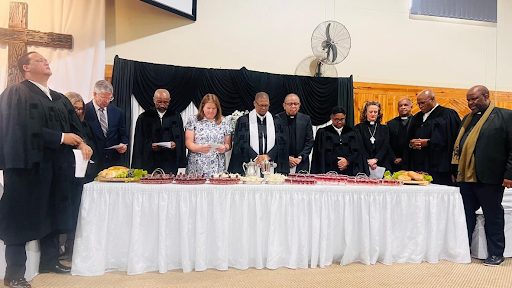
The joint statement concludes with these words and a call to the church, which I leave with you today for prayer and consideration:
We must also confess that the church itself has not been innocent. Too often, we have remained silent in the face of injustice, hesitant to speak where clarity was required, and divided where unity was demanded. We repent of our complicity, whether through silence, selective outrage, or theological ambiguity, that has allowed systems of oppression to persist under our watch. Solidarity in Christ demands not only that we stand with the oppressed, but that we turn away from all that diminishes their dignity. Repentance is not a private act of remorse; it is a public turning toward justice, truth, and courageous witness.
As followers of Jesus, the Prince of Peace, we are compelled to act. The church must stand to dismantle unjust systems and work to end the disproportionate use of power, violence, and war in Palestine and wherever injustice may be.
South Africa’s history offers not only inspiration, but also instruction. The global church played a vital role in the struggle against apartheid through advocacy, economic pressure, theological resistance, and moral clarity. Today, we ask: What lessons from that struggle must be applied to the realities in the U.S., South Africa, and Palestine and Israel?
Central to our discussions this past week were the enduring significance of the Belhar Confession born out of the struggle against apartheid. We confess racism, superiority, and privilege that are identified as sins of the church in the Belhar Confession. The Confession rejects any ideology that legitimizes separation, inequality, or oppression. Its message remains profoundly relevant today, as we confront systems that divide and dehumanize. The Belhar Confession serves as a roadmap for today by which the church may embody principles of the Good News of the Gospel in pursuit of unity, reconciliation, and justice.
We issue this statement as both a declaration and a call:
A call to the global church to fulfill our moral obligation and speak with courage and clarity.
A call for the church to repent of our unwillingness to have hard conversations and our complicity in not calling for the dismantling of any unjust systems of power and being willing to speak truth to power.
A call to governments, including the United States and South Africa, to pursue policies rooted in justice, human dignity, and international law.
A call to end all forms of violence in the United States, Southern Africa, and the Middle East; to end occupation and the collective punishment of groups, peoples, or nations.
A call to dismantle systems of apartheid wherever it exists.
A call to bring an immediate end to the genocide in Gaza and wherever genocide may be. We are living in a time of profound global brokenness, marked by war, division, and injustice.
Yet we hold fast to the promise that “the light shines in the darkness, and the darkness has not overcome it” (John 1:5). On this South African Freedom Day, may we recommit ourselves to the work of justice, peace, and reconciliation. May we walk together, in solidarity across continents and contexts, trusting that God is still at work in the world, calling us to be agents of transformation. And may we have the courage not only to pray for peace, but to pursue it.
If you are interested in learning more about the intersections of conversations around the Belhar Confession and the United States, South Africa, and the Middle East, Churches for Middle East Peace (CMEP) is hosting a mini-series about the topics. You can watch videos of the webinars that have already occurred here. The final session will include Rev. Allan Boesak, register to watch live (to be scheduled at the end of June 2026) or receive a video of the webinar discussion here.


