Christian Higher Education Trends Upward
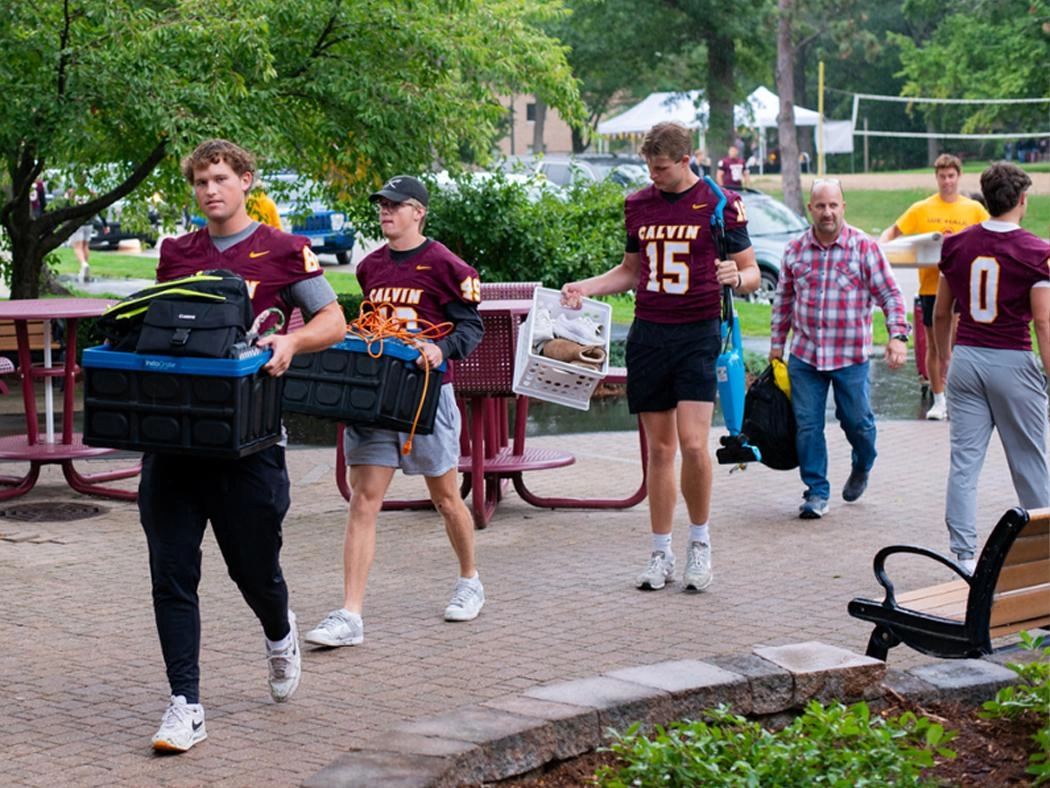
Several Reformed Christian colleges and universities are celebrating God’s faithfulness as they report steady and often rising enrollment. Calvin University, Dordt University, and Redeemer University are experiencing large or record enrollment this academic year, while Kuyper College and The King’s University are seeing steady retention rates despite a challenging academic landscape.
Calvin University welcomed over 1,000 new students to its student body for the third year in a row this fall. A press release from the university noted that the incoming class includes “first-time and transfer students joining the Grand Rapids [Mich.] campus, along with graduate students, re-enrolling students, and participants in specialized programs like the Calvin Prison Initiative.”
The leadership at Calvin University credits innovative recruitment strategies, new financial aid offerings, more opportunities for campus visits, and Calvin’s expanding reach and reputation for its 78-percent rise in applications and 35-percent increase in enrollment since 2020.
Total enrollment this year is 3,674 students, said John Zimmerman, associate director of public relations at Calvin University. He added, “We are particularly encouraged by our first-to-second-year retention rate of 88 percent, which demonstrates that students who choose Calvin are thriving here.”
The university typically welcomes students from a variety of countries, and the diversity and perspective they bring is valued in Calvin’s classrooms and community, said Lauren Jensen, vice president for enrollment strategy. However, changes and delays in the visa process for international students affected Calvin University’s fall enrollment this year. Admissions staff are hopeful that some students whose education was affected by these things will be able to enroll for the spring semester.
Dordt University in Sioux Center, Iowa, is celebrating record enrollment for the fifth year in a row, according to a recent press release, welcoming 2,077 students for the fall semester this year. This includes 540 new undergraduates and 247 graduate students. The retention rate for first-to-second-year students is 84 percent.
“This year’s numbers have exceeded even our most optimistic expectations,” said Greg Van Dyke, vice president for enrollment. He believes the growing enrollment is a response to Dordt’s commitment to excellence and equipping students and its strong programs, focus on Christ, and positive campus life, along with support from alumni and the broader community.
“Dordt continues to stay true to its mission as a Reformed Christian university, and it’s been encouraging to see students deeply engaged in the faith formation that happens here,” said Van Dyke. He added, “It’s a joy to see how God is using this community to shape students for lives of service and purpose.”
Redeemer University in Ancaster, Ont., also celebrated record enrollment this fall, welcoming 1,117 students to campus this year, including 360 new students. Students come from all 10 Canadian provinces as well as 27 countries, representing 55 church denominations, according to a recent news story.
“It’s exciting to see the Redeemer community continue to grow and attract new students,” said president David Zietsma. “We remain committed to offering a Christian university education that prepares students to reflect the love of Jesus Christ in every career and calling.”
Some pull factors for students choosing Redeemer are the university’s biblically faithful education, thriving campus community, tuition rates comparable to other Ontario universities, and academic excellence. Numbers are expected to continue to grow, as applications open soon for Redeemer’s first graduate program, which will be Canada’s only Christian master of education program.
Jim Steenbergen, chief advancement officer at Kuyper College in Grand Rapids, Mich., reported that the school has experienced a 16 percent increase in enrollment since the COVID-19 pandemic, while keeping steady retention rates. He credits the scriptural, Christ-centered education available at Kuyper College, as well as a growing athletics program and a strong campus life, for these trends.
“In addition, as the only federally recognized work college in Michigan, Kuyper has experienced growth among students interested in gaining valuable work experience that benefits them as student staff and reduces their educational costs. Together these factors highlight Kuyper’s ability to meet the needs of today’s students while remaining firmly committed to its mission,” he noted.
The King’s University in Edmonton, Alta., saw a 13-percent increase in domestic student enrollment this fall, said Shannon Tuininga, the university’s vice president for institutional advancement. The university’s numbers have been fairly steady in recent years, with some modest enrollment growth. A slight drop from 838 to 828 in total enrollment this year appears to be related to a new federally regulated cap on international students in Canada, which led to a 70-percent decline in new international student enrollments, said Tuininga.
This year’s high and in some cases record-setting enrollment numbers at Reformed Christian universities and colleges may seem low compared to those at public universities, where student bodies may number in the tens of thousands. But lower student-to-faculty ratios and a closer sense of community on campus can also be viewed as strengths.
According to an article in Christianity Today earlier this year, 30 evangelical colleges and universities saw significant enrollment growth in 2024. While higher education enrollment is generally trending downward, Christian universities on the whole are faring better than most. Factors that seem to help are a clear, Christ-centered focus, active and welcoming campus communities, intentional efforts to attract both domestic and international students, and financial incentives such as on-campus work or scholarships to make higher education more affordable.
“We recognize that the higher education landscape remains complex. Factors like government policies on visas, shifting financial-aid programs, and increased competition play a role in shaping enrollment. But, overall, we are very encouraged by the resilience of Christian higher education,” said Zimmerman.
Reflecting on enrollment trends at Dordt University, president Erik Hoekstra stated, “It’s not our efforts driving this, it seems to me. It’s God’s faithfulness to Dordt and our fixation on preparing these students to take their place as effective citizens of Christ’s coming kingdom. To God be the glory for the momentum he’s building here.”
Note: Upon receiving requests for information to be included in this story, Trinity College in Palos Heights, Ill., declined to comment.


